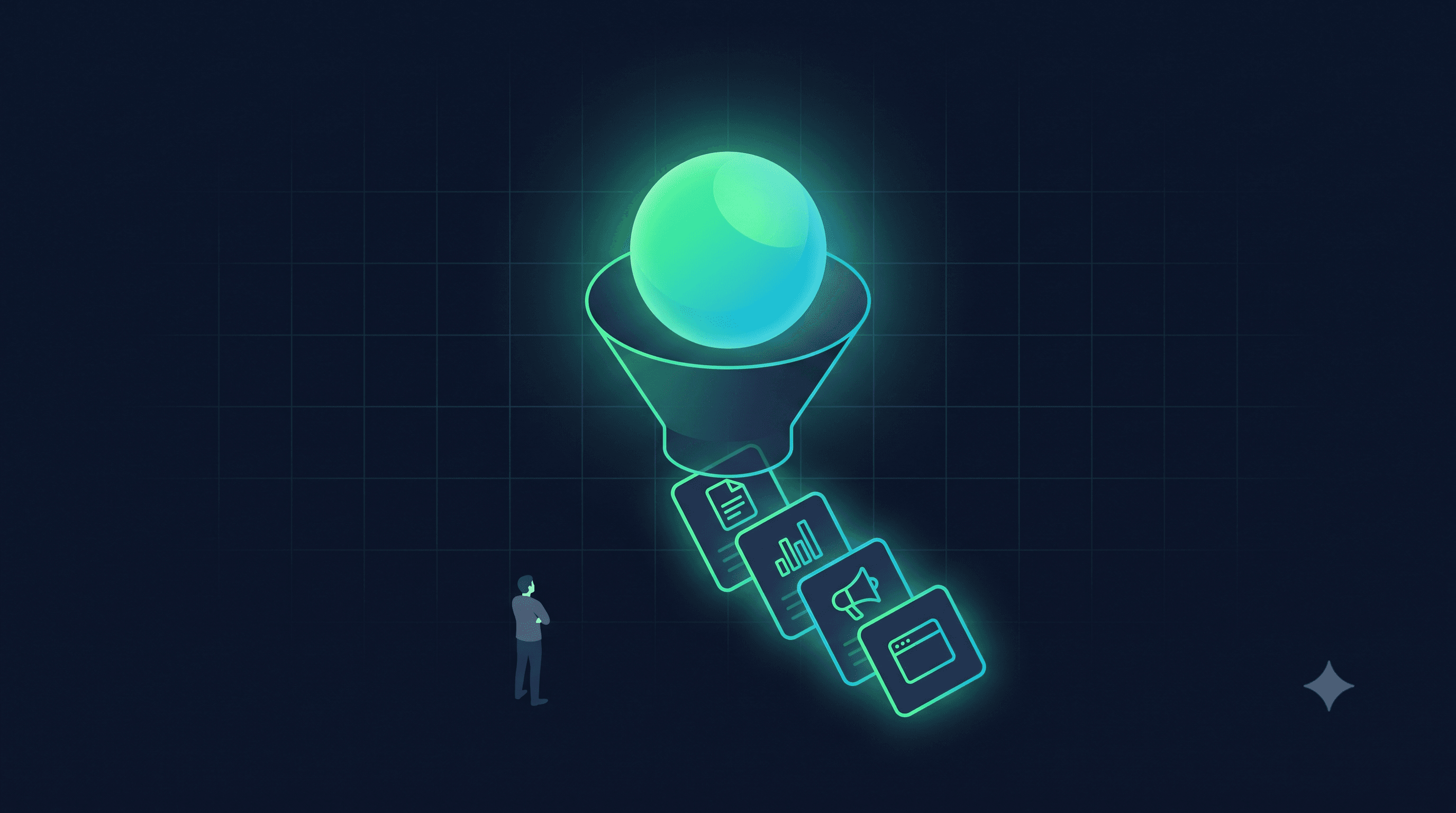
On July 9, OpenAI launched ChatGPT Work, a mode within ChatGPT that doesn't deliver drafts for you to edit: it delivers finished work. And the example OpenAI chose to present it wasn't generic. It was, literally, the work of a marketing agency: take customer research, turn it into a campaign brief, generate assets and adapt them by market, all in a single session with a single prompt. If you work at a digital agency, that sentence should make you a little uncomfortable. It made us uncomfortable, and that's why it's worth talking about this today instead of waiting for it to become a LinkedIn trend in three months.
What ChatGPT Work is, specifically
ChatGPT Work isn't a chatbot on steroids. It's an agent that takes a business objective, breaks it into steps, executes, reviews its own result, and only comes back to you when it needs a decision or when the work is done. According to coverage from Entrepreneur and the launch analysis published on digitalapplied.com, the mode can solve seven types of tasks for a solo business:
- A content dashboard for social media
- A functional website built from a brief in natural language
- A complete marketing campaign over 90 days
- An audit that identifies the exact point where qualified leads are being lost
- An SEO-optimized blog draft, ready to publish
- A business review in "Monday meeting" style
- Continuous training of an AI assistant with business context
The data point that caught our attention most: OpenAI presented as a use case the generation of a 90-day marketing campaign of the type that traditionally bills five figures to an agency, solved in a single session. That's not a minor detail—it's the product's explicit positioning.
Why this isn't "just another AI launch"
We've been seeing tools for two years that generate copy, images, or code. All of them required someone—you, your team, the client—to take that output and turn it into something usable: edit it, approve it, integrate it, add brand context. ChatGPT Work is designed to skip that step. The promise isn't "I'll help you write the brief," it's "here's the brief, the assets, and the market adaptation, already integrated." That's the difference between a productivity tool and a deliverable substitute.
This connects to something we've been discussing internally since Fable 5 launched and the wave of agent harnesses that all the big labs released in mid-July: the conversation is no longer "how good is the model," it's "how ready is the orchestration infrastructure to replace entire processes, not just individual tasks." ChatGPT Work is the first time that shift is explicitly packaged against the business model of agencies.
The mistake of treating this as a threat to ignore
The easy reaction is two extremes: panic ("agencies are dead") or denial ("big clients will always need humans"). Both are lazy. What is true is that the segment ChatGPT Work attacks first—solo businesses, freelancers, small companies that hired basic content and campaign packages—is exactly the entry segment for many agencies, including ours a few years ago. That pure production work (generating assets, building a content calendar, writing a generic blog post) was always the easiest to commoditize. Now it has a competitor that charges a monthly subscription instead of a five-figure proposal.
What it does NOT attack—yet—is work that depends on undocumented context: the relationship with the client, the judgment to decide which campaign is worth running, the legal and reputational responsibility when something goes wrong, and the ability to connect marketing decisions with product and business decisions. That's still human because it requires judgment with consequences, not just execution.
The real limit is who answers when something fails
An agent can generate a complete campaign, but it can't sign a contract, can't sit down with the client when the campaign doesn't convert, and can't decide whether it's worth risking the brand's reputation to test an aggressive angle. That "who answers" is the asset agencies still haven't figured out how to package and charge for explicitly. As long as we keep selling production hours instead of accountability, we keep competing on the terrain where a $20-a-month agent almost always wins.
What this means for agencies
If your agency still sells production hours—writing, designing, building decks, generating reports—that's exactly the work ChatGPT Work is designed to absorb first. The actionable lesson isn't "compete on speed against an agent," because you've already lost that race. The lesson is to audit your own process and separate two categories:
- Production: what can be described in a clear brief and verified with a checklist. This gets automated, period. Denying it just delays the inevitable.
- Judgment with consequences: decisions that require knowing the client, taking responsibility for the outcome, and connecting dots across areas that an agent still doesn't see together.
Concretely, this means reviewing three things this week, not next quarter:
- Your commercial proposal: how much of what you quote is pure production and how much is judgment with consequences? If you can't answer that question line by line, your pricing is already outdated.
- Your internal stack: if your team is still manually building briefs, content calendars, or reports, those hours should be compressed with tools like ChatGPT Work or equivalents, and reinvested in strategy and client relationships.
- Your narrative with clients: stop selling "we produce your content" and start selling "we're responsible for making your marketing investment work, and we use AI to execute faster than your internal team could alone."
At Geek Vibes we've already started restructuring proposals to charge explicitly for the second category—strategy, integration, accountability—and use tools like this to brutally compress the time we spent on the first. It's not an abstract threat: it's a concrete reason to act now.
If you want to chat about how we're redesigning processes and pricing at Geek Vibes in the face of this type of tool, or if you're worried about where your own business model is headed, write us at comercial@geekvibes.agency.