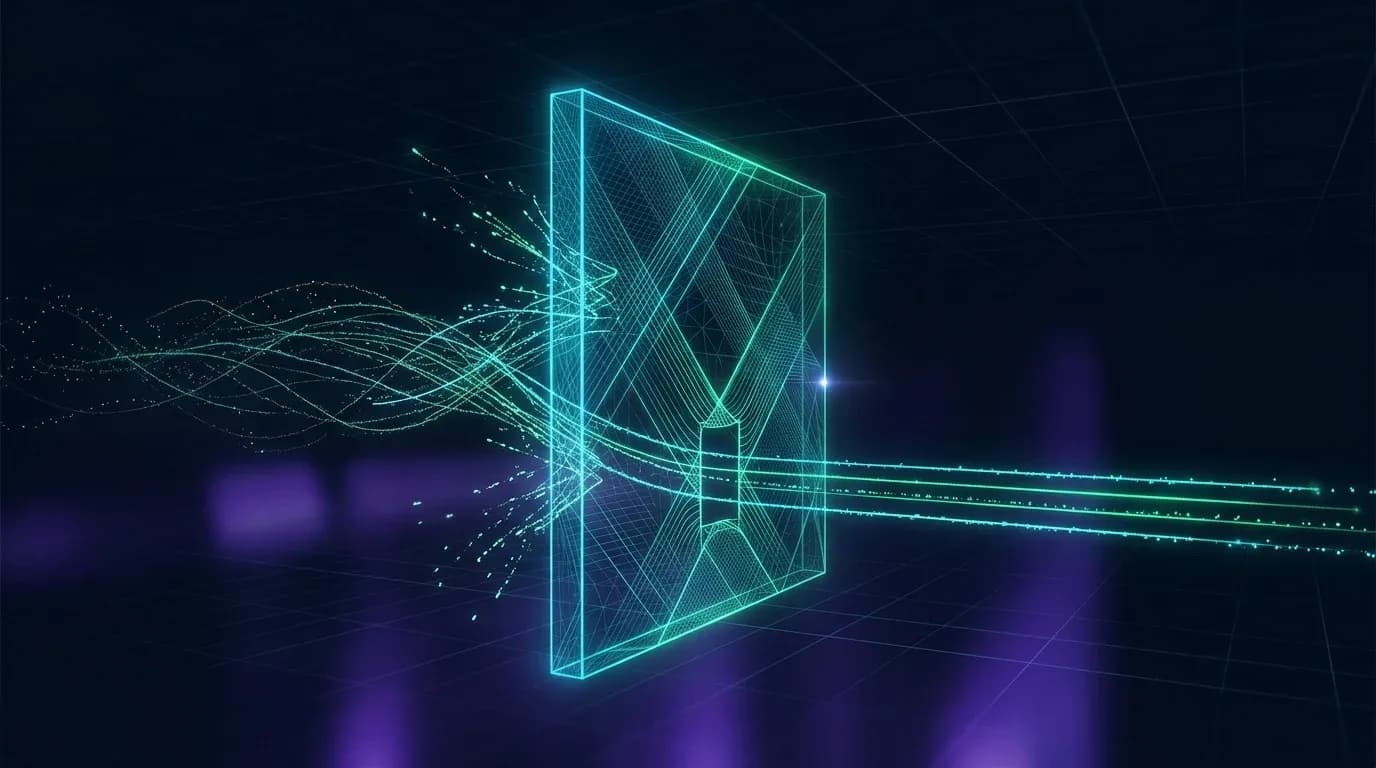

On October 7, OpenAI switched on Intelligent UI inside ChatGPT: the feature that makes the chat stop answering with text alone and start building buttons, charts, forms and even mini-tools on the spot, depending on what you ask. The next day — today, October 8 — the feature also reached free users. It matters now because this is not a cosmetic tweak to ChatGPT: it is the first mass rollout of "generative UI" to a base of more than 1.2 billion weekly users, and it suddenly moves the question of who designs an interface into territory that until yesterday belonged almost exclusively to product teams and design agencies.
What Intelligent UI actually is
Until this week, ChatGPT answered with text, and at most with a table or a generated image. With Intelligent UI, the model decides on its own which format suits each answer: a comparison appears as side-by-side cards, the explanation of an abstract concept becomes an interactive diagram you can manipulate, and a simple question still gets plain text. In the examples OpenAI showed, a Sunday barbecue plan includes a guest calculator that automatically adjusts shopping quantities, and an explanation of the Monty Hall problem arrives as a simulation you can run yourself.
What makes this technically different from a simple "HTML generator" is that OpenAI built a library of native, streamable interface components, plus a compiler that renders the interface while the model is still generating the answer — which is why parts of the interface appear before it finishes "thinking." The model can even build complete tools inside the conversation: a retirement calculator, a restaurant bill splitter, or a simple game.
Who gets this and when
- GPT-6 Sol reaches Plus, Pro, Business and Enterprise users (Enterprise access depends on the administrator's configuration).
- GPT-6 Luna reaches Free and Go users starting today, October 8.
- The Work and Codex models — the ones development teams use inside workflows and coding agents — do not change with this launch. OpenAI deliberately separated the conversational experience from the productivity and coding one.
The data point that should catch your attention (and it is not the one repeated most)
Most of the coverage stopped at the visuals: "look, ChatGPT now makes buttons." The data point that really matters for anyone building product is a different one: on queries that require web search, GPT-6 Instant starts answering 44% faster on average than GPT-5.6 Instant, according to the internal evaluation OpenAI published. That is not a UX detail — it is a sign that OpenAI optimized perceived latency at the same time as it added a full layer of dynamic rendering, something that normally strains any system, because more rendering almost always means slower. That it managed the opposite — lowering latency while making the interface more complex — says more about the engineering behind it than any interactive chart in the demo.
Why this is not just an OpenAI story
This is not the first time an assistant has generated interfaces on the fly — Anthropic, Google and several startups have been exploring "generative UI" since 2025 — but it is the first time it arrives by default, without the user asking, to more than a billion people in a single week. That changes the conversation from "does generative interface work?" to "what part of interface design work still has value when the model generates it for free, inside the chat people already use every day?"
For any agency or studio that quotes UI design hours — panels, forms, simple dashboards, calculators, configurators — the question stops being hypothetical.
What this means for agencies and developers
It is not that product design becomes unnecessary — it is that the most generic and repeatable part of that work starts to have a free competitor inside the chat your clients, and your clients' clients, use. This is what we are adjusting in how we quote and sell interface work:
- Stop quoting "making a pretty interface" as the main deliverable. If the value of your proposal is "we build you screens," a tool that generates screens for free inside a chat will eat your margin first on the simplest projects — calculators, forms, configurators. The defensible value is in the data, the integration and the business flow behind the screen, not in the screen itself.
- Review how "generic" each interface you build is. A standard reporting dashboard or a data-capture form are direct candidates for commoditization. A flow with specific business logic, integrations with internal systems, or compliance rules particular to the client's industry is not.
- Bring real accessibility into the conversation with your clients. An interface generated on the spot by a model does not automatically pass a WCAG criterion, and OpenAI did not publish accessibility data for Intelligent UI in its announcement. If your client needs real compliance — government, health, finance — that remains human, audited work, not something generated on the fly.
- Watch the separation between "conversational chat" and "productivity tools." OpenAI left Codex and Work out of this change on purpose. It is a sign that, even for them, generating UI on the fly is not yet reliable enough for serious workflows — exactly where a professional agency still has an edge over what comes out "free" from the chat.
The underlying lesson is not "watch out, they are going to take our work" — it is that the easy-to-automate part has already been automated, in public, in front of a billion users. What is not yet automated — business judgment, systems integration, legal responsibility for what you build — is exactly where any agency's pitch should sit today.
At Geek Vibes we are already adjusting how we quote interface work with clients who ask us "why am I paying you if ChatGPT already does this?" — and the answer is never "it doesn't," it is "here is what it still can't do." If you want an honest read on which part of your product remains defensible against generative interfaces and which part you should already stop quoting as if it were handcrafted work, write to us at comercial@geekvibes.agency.