On October 6th, Sierra and Meta published the Personal Agent Protocol (PAP): an open standard for personal AI agents —the one that buys for you, the one that cancels your flight, the one that negotiates a return— to stop pretending to be humans clicking buttons and connect directly to a company's systems. Walmart, Shopify, Stripe, Genesys, and Rocket Companies already signed as launch partners. It matters today because it didn't stay in a press release: 48 hours later, Decagon already published open-source code for a rival protocol (PACT) and Sierra launched a tool that detects whether who's calling you is, in reality, an AI agent. The race to decide how your customer is going to shop next year has already begun, and almost no agency in LATAM is watching it yet.
What the Personal Agent Protocol solves
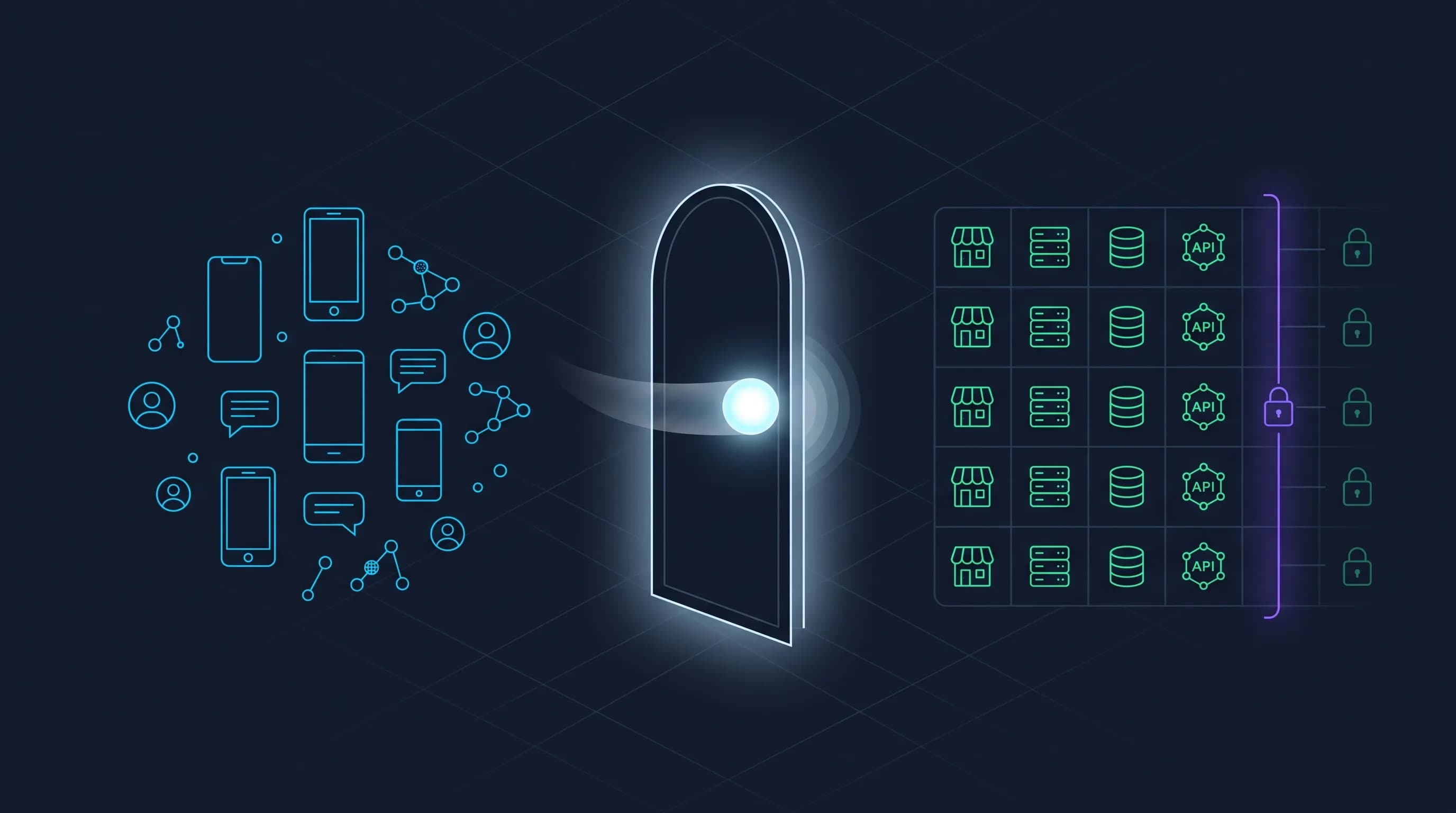
Today, when a personal agent —your customer's assistant, not yours— tries to do something on a site you didn't build with AI in mind, it does the same thing a person would: navigates the site, fills out forms, and when something breaks, it falls back to phone support or live chat. It's slow and often doesn't complete the task. PAP proposes a direct connection that solves that in seconds, with three design rules:
- The consumer decides what access they give their agent —can start as a guest (checking availability, return policy) or sign in for account tasks, choosing read-only access or also write access.
- The company decides what an agent can touch within its own system, with OAuth-based sessions that persist across channels during the same visit.
- There are three "entry doors": the company's website, its APIs (built on MCP and OpenAPI), or the company's own conversational agent for tasks like a warranty claim.
The complete v0.1 specification still isn't public —Sierra promised to publish it "later this month"— but the final objective is clear: more granular permissions per action, push notifications (a flight delayed, an order shipped) and, eventually, payments without the agent needing to see your card number.
The data almost no one is covering
While Sierra was announcing PAP without a public specification, Decagon published the same day a competing protocol, PACT, with Apache-2.0 license and actual code: schemas in TypeScript, a reference provider, a demonstration agent, and compliance tests that anyone can run right now. PACT uses A2A agent cards for discovery, specific permissions like orders:read or orders:cancel, and short-lived JWTs to sign each request. Put another way: while one side launched the promise of a standard, the other launched the standard working. That difference will decide which the industry adopts first, not the names of the companies backing it.
Who's in —and who stayed out on purpose
The list of PAP launch partners says as much by what it includes as by what it omits:
- Inside: Meta, Walmart, Shopify, Stripe, Genesys, Rocket Companies, and Instinct. Stripe already declared itself a "founding member" through Jeff Weinstein, its payments lead.
- Outside any launch announcement: OpenAI, Anthropic, Amazon, Google, Salesforce, and Zendesk —the names that, in theory, will build or distribute the most personal agents in the next two years.
- The detail that most reveals the real tension: according to September reports, Amazon already blocked Muse, Meta's agent, from its own retail site. It's no coincidence that Meta is pushing an "open" protocol at the same time its agent gets locked out of the largest e-commerce site in the United States. This isn't pure collaboration: it's also a power play over who controls the gate to AI-assisted commerce.
Analysts like Larry Dignan, from Constellation Research, compare it directly to the moment when MCP: a very early and incomplete specification that, even so, could be adopted quickly simply because the right players are already sitting at the table.
The questions the protocol still doesn't answer
Neither Sierra nor Meta have a public answer for the following, and they're exactly the ones your client will ask first:
- Who answers when an agent makes a mistake? If an agent cancels the wrong order or accepts terms the customer didn't want, there's no defined dispute mechanism yet.
- Does OAuth authenticate the agent or the person? Critics like Mike Moore pointed out on social that OAuth identifies the consumer, not the agent process —and a copied token keeps working until it expires, no matter who uses it.
- Sierra itself admits this won't enforce itself. That's why it launched, on October 8th, fleming-1: a tool that analyzes in real time the voice of whoever's calling to detect if it's AI-generated, tuned to be "conservative by default". If the protocol actually worked, you wouldn't need an agent-detector pretending to be human the day after the announcement.
What this means for agencies, developers, and brands in LATAM
None of this is yet a standard you need to implement this week —but it is the first serious signal of where your customers' traffic is headed, and there's concrete work you can start now:
- Audit how "readable" your client's site is to an agent, not just to Google. Return policies, availability, and prices scattered across PDFs or ambiguous copy are exactly the kind of friction an agent will fail to resolve —and that today ends up as a missed call to support.
- Separate, from now on, agent traffic and human traffic in your reports. If your analytics still assume each session is a person, you're a few months away from reporting numbers to your client that don't mean what they think they mean.
- Don't build against PAP yet if there's no public spec —but it's worth trying PACT, because it's the only one of the two that has real code running today. Betting on a promise of a standard before the spec exists is the same mistake we already saw with other agent protocols this year.
- Prepare your e-commerce clients for the access control question. They'll need to decide soon what an external agent can do inside their account without human supervision —and that governance conversation is exactly the type of strategy work an agency should be pricing separately, not giving away inside a design or ads project.
The underlying lesson is the same we've seen with MCP and A2A: when a half-dozen big players sit down to define how something is going to work, the technical standard takes months to stabilize, but the power decisions —who gets in, who gets left out, who controls the gate— were already made on day one of the announcement.
At Geek Vibes we're already reviewing with e-commerce and retail clients how prepared their sites and APIs are for a wave of non-human traffic, and helping them decide how much access they give to an agent that no one has finished auditing yet. If you want us to run that diagnosis with your brand or your client's, write to us at comercial@geekvibes.agency.